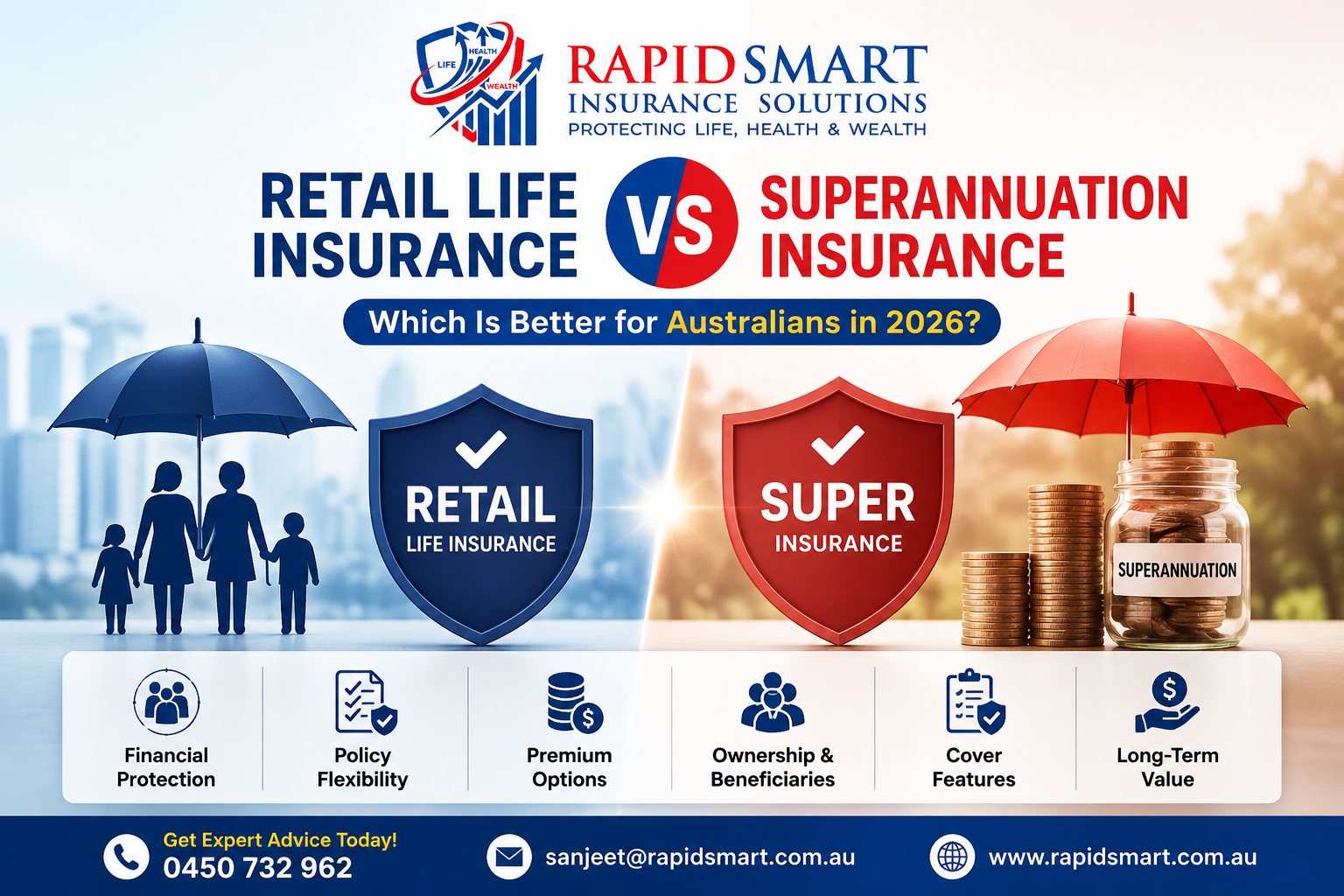
Retail Life Insurance vs Superannuation Insurance: Which Is Better for Australians in 2026?
Introduction
Most Australians end up with some form of life insurance almost by accident. You join a super fund, and a modest life insurance and total permanent disability (TPD) policy comes bundled in without you ever comparing it to anything else. It's only later — when you're buying a home, having kids, or reviewing your finances — that the question comes up: is the cover inside your super fund actually enough, or would a retail policy serve you better?
This comparison matters more in 2026 than it used to. Premiums have shifted, super funds have tightened default cover in response to regulatory pressure, and more Australians are working as contractors or business owners where standard group cover doesn't fit well. Choosing between retail life insurance and super insurance isn't just a paperwork exercise — it affects how much your family receives if something happens to you, how long a claim takes, and whether you're paying for cover you don't actually understand.
This guide walks through both options in plain English, compares them side by side, and looks at which one tends to suit different life stages and circumstances.
What is Retail Life Insurance?
Retail life insurance is a policy you buy directly — either through a financial adviser, an insurance broker, or straight from an insurer — outside of your superannuation fund. You choose the insurer, the amount of cover, the type of policy, and you own the contract personally.
Key features:
- You select your own sum insured rather than accepting a default amount
- Premiums are usually paid from your bank account, not your super balance
- Cover typically requires full medical underwriting at application, which can mean blood tests, medical history questionnaires and sometimes a GP report
- Because underwriting happens upfront, retail policies tend to have fewer surprises and exclusions at claim time
- You retain ownership of the policy even if you change jobs or move your super fund
Flexibility is the standout feature of retail cover. You can add features like guaranteed insurability (increasing cover at life events without new underwriting), agreed value income protection, and stepped or level premium structures. You can also bundle life, TPD, trauma and income protection into one policy or keep them separate.
Because retail policies are individually underwritten, insurers assess your specific health, occupation and lifestyle at the time you apply. This generally means a more accurate premium for your risk profile, though it can also mean a higher starting premium than the equivalent default cover in super.
What is Superannuation Life Insurance?
Superannuation life insurance is cover that sits inside your super fund. For most employees, some level of life and TPD cover is applied automatically when you join a fund, provided you meet age and balance requirements — this is often called default cover.
Key features:
- Cover is usually arranged on a group insurance basis, meaning the fund negotiates one policy that covers all eligible members
- Default cover starts automatically, often without any medical underwriting at all, which is why it's accessible even to people who might struggle to get retail cover approved
- Premiums are deducted directly from your super balance, not your take-home pay — which feels less painful day to day, but quietly erodes your retirement savings over time
- Cover amounts are usually formula-based (for example, tied to age and account balance) rather than chosen by you
- Limitations are common: default cover often reduces or ceases at a certain age, and inactive accounts can have cover cancelled under "protecting your super" rules if no contributions are received for 16 months
Because there's little or no underwriting at the start, super insurance is a genuinely useful safety net for people who might not otherwise qualify for cover, or who simply haven't gotten around to arranging anything else. The trade-off shows up later — often at claim time — when the insurer may ask detailed health questions retrospectively.
Retail Life Insurance vs Super Insurance: Side-by-Side Comparison
| Feature | Retail Life Insurance | Super Insurance |
|---|---|---|
| Ownership | Owned personally by you | Owned by the super fund trustee on your behalf |
| Premiums | Paid from personal cash flow | Deducted from your super balance |
| Flexibility | High — choose sum insured, features, structure | Low — mostly formula-based default amounts |
| Coverage | Can include life, TPD, trauma, income protection | Usually life and TPD; trauma rarely included |
| Medical underwriting | Full underwriting at application | Often none for default cover (assessed later at claim) |
| Claims process | Generally more direct, insurer-led | Involves the trustee, which can add time |
| Policy portability | Stays with you regardless of job or fund changes | Tied to the fund; can lapse if you switch funds |
| Tax treatment | Premiums generally not tax-deductible (personal cover) | Premiums paid pre-tax from super, which can lower cost |
| Beneficiary options | You nominate beneficiaries directly, flexible wording | Governed by super law; binding nominations have stricter rules |
| Customisation | Extensive — riders, indexation, ownership structures | Minimal — take-it-or-leave-it default settings |
| Waiting periods | Set at application, chosen by you | Standard fund terms, less negotiable |
| Renewal | Reviewed with your adviser as needs change | Rarely reviewed unless you act |
| Affordability today | Often higher premiums upfront | Lower upfront cost, funded from super |
| Long-term value | Cover keeps pace with life changes if reviewed | Can become inadequate as balance-based formulas shift |
| Claims support | Adviser or broker can assist throughout | Trustee support, sometimes slower and less personal |
Advantages of Retail Life Insurance
- You choose your own cover amount, based on your actual mortgage, debts and family needs rather than a generic formula.
- Wider range of cover types, including trauma insurance and agreed-value income protection, which most super funds don't offer.
- Underwriting happens upfront, reducing the risk of a claim being challenged later over undisclosed health information.
- Cover is portable — One benefit many Australians appreciate is portability. If you change employers or move to another super fund, your retail policy usually stays with you.
- No erosion of retirement savings, since premiums come from your income rather than your super balance.
- Guaranteed insurability options let you increase cover after major life events (marriage, a new baby, a bigger mortgage) without new medical checks.
- Ownership structures can be tailored, including self-owned, spouse-owned or business-owned policies for succession planning.
- Stepped or level premium choice gives you control over whether costs stay flat for longer or rise with age.
- Faster, more predictable claims, since the insurer already holds full underwriting information.
- Better suited to high-income earners and business owners who need cover well above default super limits.
Advantages of Super Insurance
- Cover starts automatically for many employees, offering protection to people who might otherwise have none.
- No medical underwriting to get default cover, which helps people with pre-existing conditions get some level of protection.
- Premiums come from your super balance, so there's no direct hit to weekly cash flow.
- Group insurance rates can be cheaper than individually underwritten retail premiums for younger, healthier members.
- Tax efficiency, since premiums are effectively paid with concessionally taxed super contributions.
- Simple to access, with no application forms or health questionnaires required for base cover.
- A reasonable starting point for people early in their careers who aren't ready for a full retail policy.
- Consolidated with retirement savings, making it easier to track in one place.
- Useful safety net for casual or part-time workers who might struggle to get approved for retail cover.
- Fund-negotiated terms mean the trustee has already done some due diligence on the insurer.
Disadvantages of Retail Insurance
- Premiums are generally higher upfront, especially for older applicants or those with health issues
- The application process takes longer due to full underwriting
- Premiums must be paid from personal cash flow, which can feel like a bigger burden
- Requires more active decision-making — you have to choose amounts, structures and features
- Without an adviser, it's easy to over-insure or under-insure
Disadvantages of Super Insurance
- Default cover amounts are often insufficient for people with mortgages, dependants or business debts
- Underwriting is deferred to claim time, which can lead to disputes over pre-existing conditions
- Cover can lapse if your account becomes inactive for 16 months under "protecting your super" legislation
- Premiums quietly reduce your retirement balance over decades
- Limited or no access to trauma cover
- Cover typically reduces or stops at a set age, regardless of ongoing need
- Less flexibility to customise beneficiary nominations compared with retail ownership structures
Which Option Is Better? It Depends on Your Situation
Young professionals: Default super cover is a reasonable starting point, but it's worth reviewing the sum insured against actual debts and lifestyle costs early rather than assuming it's enough.
Families with a mortgage: Retail cover, or a combination of retail and super, usually makes more sense — default cover rarely matches the real cost of a mortgage plus ongoing family expenses.
Parents: Trauma and income protection become more important once there are dependants, and these are areas where retail policies generally offer far more depth than super.
Business owners: Retail cover, often structured for buy-sell agreements or key person insurance, is usually essential — super insurance isn't designed for business succession needs.
Self-employed professionals: Income protection through a retail policy, with agreed value options, tends to suit irregular income far better than a fund's default terms.
High-income earners: Default super cover caps are usually well below what's needed to protect a high income, making retail top-up cover important.
Low-income earners: Super insurance can be a practical, low-cost way to maintain some cover without straining weekly cash flow.
Nearing retirement: It's worth checking age-based reductions in super cover, since many policies wind back or cease cover in your 60s.
Retirees: Ongoing life insurance needs are usually lower, but any remaining debts or estate planning goals should be reviewed rather than assumed to be covered.
Real-Life Australian Examples
Case 1 — The young family in Western Sydney: A couple in their early 30s with a new mortgage discovered their combined super default cover would only clear about a third of their home loan. After a review, they added a retail life and TPD policy sized to the mortgage, keeping their super cover as a smaller supplementary layer.
Case 2 — The sole trader in Geelong: A self-employed electrician had no default super cover at all, since contributions to his fund had been irregular. He arranged a standalone retail income protection policy, giving him a monthly benefit if he couldn't work due to injury — something his super fund could never have provided given his inactive account.
Case 3 — The corporate employee in Brisbane: A marketing manager in her 40s assumed her super fund's default cover was adequate until a work colleague's claim was delayed over an underwriting query about a pre-existing back condition. She switched her personal cover to a fully underwritten retail policy for peace of mind, while keeping a small super policy as a backup.
Common Mistakes Australians Make
- Assuming default super cover automatically matches their mortgage or income needs
- Never checking whether their super account has become inactive, risking cover cancellation
- Holding multiple small default policies across several super funds instead of consolidating
- Not disclosing full medical history accurately, risking a declined claim later
- Ignoring income protection entirely, focusing only on life and TPD
- Failing to review cover after major life events like marriage, children or a new mortgage
- Choosing the cheapest premium without checking what's actually excluded
- Letting an adviser-free retail policy lapse due to missed payments
- Not understanding the difference between agreed value and indemnity income protection
- Assuming trauma cover is automatically included in super insurance, when it usually isn't
- Overlooking how premiums inside super reduce long-term retirement savings
- Not naming a valid, up-to-date beneficiary nomination on either policy type
Frequently Asked Questions
1. I've already got life insurance through my super fund. Do I really need another policy? Yes, for many people it's a useful baseline, particularly early in a career. The key is checking whether the default amount is actually enough rather than assuming it is.
2. Can I have both retail and super insurance at the same time? Yes. Many Australians hold a smaller default policy in super alongside a larger, more tailored retail policy for the cover that matters most.
3. Why is retail insurance more expensive than super insurance? Retail policies are individually underwritten based on your specific health and occupation, while super cover is often priced on a group basis with little or no underwriting upfront.
4. Does super insurance cover trauma or critical illness? Rarely. Most super funds offer life and TPD cover only, with trauma insurance generally only available through retail policies.
5. What happens to my super insurance if I change jobs? It depends on your fund. If you stop contributing and the account becomes inactive for 16 months, cover can be cancelled under "protecting your super" rules unless you opt to keep it active.
6. Is it harder to claim on a super insurance policy? Claims can take longer because they involve both the insurer and the super fund trustee, and underwriting questions are sometimes raised at claim time rather than upfront.
7. Are retail insurance premiums tax-deductible? Generally, life insurance premiums for personal cover are not tax-deductible, though income protection premiums often are. It's worth confirming your specific situation with a tax professional or the ATO.
8. How much life insurance do I actually need? A common approach is to add up debts (mortgage, loans), ongoing income replacement needs, and future costs like children's education, then subtract existing savings and cover.
9. Can I increase my super insurance cover without medical checks? Some funds offer limited automatic increase options at set life events, but it's far less flexible than the guaranteed insurability features common in retail policies.
10. What is TPD insurance and do I need it separately? TPD insurance pays a benefit if you're permanently unable to work due to injury or illness. It's often bundled with life cover in both retail and super policies, but the definitions and payout terms can differ significantly between the two.
11. Is income protection available through super? Some super funds offer a basic income protection option, but retail policies typically offer more comprehensive definitions, longer benefit periods and agreed value structures.
12. Should self-employed people rely on super insurance? It's risky, since self-employed contributions to super can be irregular, increasing the chance of an inactive account and lapsed cover. A standalone retail policy is usually a safer foundation.
13. What's the difference between stepped and level premiums? Stepped premiums start lower but increase each year as you age; level premiums start higher but stay more stable over time. Retail policies usually let you choose; super cover typically only offers stepped pricing.
14. Do I need a financial adviser to compare these options? It's not compulsory, but given how different the two structures are, a licensed adviser or broker can help match cover types and amounts to your actual circumstances.
15. How often should I review my life insurance? As a general guide, reviewing cover after any major life event — a new home, a child, a new job, or a business change — helps ensure your policy still reflects your real needs.
Key Takeaways
- Retail life insurance offers more control, wider cover types and portability, but generally costs more upfront and requires full underwriting.
- Super insurance is convenient and accessible, often with no underwriting, but default amounts are frequently inadequate and premiums quietly reduce retirement savings.
- Many Australians benefit from a combination of both — a base level of cover in super, topped up with a tailored retail policy.
- Reviewing cover after major life events is one of the simplest ways to avoid being underinsured.
- The right structure depends heavily on employment type, income, dependants and existing debts.
Get Personalised Advice from Rapid Smart Insurance Solutions
Choosing between retail and super insurance isn't a one-size-fits-all decision, and getting it wrong can leave your family underinsured exactly when it matters most. The team at Rapid Smart Insurance Solutions can review your existing cover — whether it's sitting inside your super fund or nowhere at all — and help you build a policy mix that actually fits your life.
Whether you need life insurance, TPD insurance, income protection, or trauma cover, a personalised review is the best way to make sure you're not paying for the wrong cover — or worse, relying on cover that isn't there when you need it. You can also check out our private health insurance options, or learn more about us before getting in touch.
This article provides general information only and does not constitute personal financial advice. For guidance specific to your circumstances, consider speaking with a licensed financial adviser, or refer to resources from ASIC's MoneySmart, the ATO, or APRA.